 Williamsburg Therapy Group
What Is Maladaptive Daydreaming? Test, Symptoms, and How to Stop

You daydream. Everyone does, and most of the time it is harmless, even pleasant. But maybe yours stopped being a passing distraction a while ago....


Key Takeaways
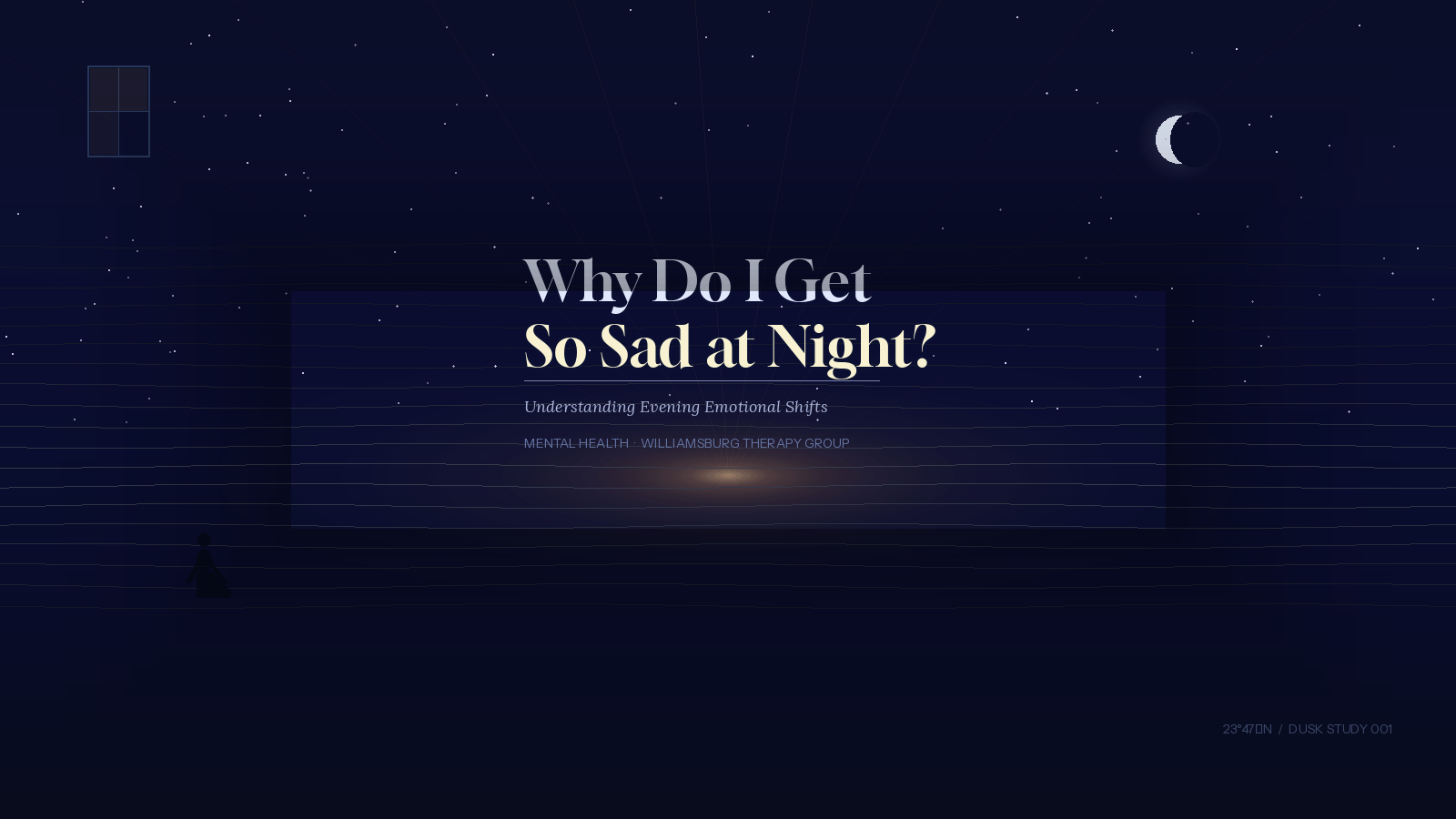
The day is winding down. The notifications slow, the noise fades — and then, almost on cue, a heaviness settles in. Maybe it's a vague sadness you can't quite name. Maybe it's loneliness, or a replaying of everything that went wrong, or just a feeling that something is missing and you can't figure out what.
If you've noticed that your mood reliably dips after dark, you're not imagining things — and you're far from alone. Many people experience what's sometimes called "evening emotional shift," a pattern where difficult feelings intensify at night. Understanding why this happens is the first step toward changing it.
During the day, most of us are in "doing" mode. Work, errands, conversations — these activities give our minds somewhere external to focus. Busyness isn't necessarily avoidance; it's just how daytime functions. But when the structure of the day ends, so does that natural distraction.
Without a task to complete, the mind turns inward. Worries that were running quietly in the background suddenly have center stage. Feelings you didn't have bandwidth to process earlier in the day finally get airtime — and they often arrive all at once.
Cortisol, the hormone that helps regulate alertness and stress response, naturally decreases in the evening. You might expect that to feel relaxing — and sometimes it does. But for people prone to anxiety or low mood, lower cortisol in the evening can reduce the biological buffer that helps you cope during the day. The result is that emotions feel rawer, less manageable.
At the same time, blue light reduction and natural darkness trigger melatonin production, which can amplify feelings of stillness and introspection — helpful for sleep, but less helpful if you're already struggling emotionally.
For many people, nighttime is the first moment of real quiet in the day — and for some, that quiet is unwelcome. If you've been carrying grief, stress, loneliness, or unresolved conflict, the absence of distraction gives those feelings room to expand.
This doesn't mean you're doing something wrong. It often means your feelings have been waiting patiently for a moment of stillness. The discomfort you're feeling at night may be your inner life asking for attention it hasn't been getting.
Occasional sadness at night is a normal human experience. But if your evening mood shifts are frequent, intense, or starting to affect your sleep, your relationships, or how you feel about yourself, it may be worth looking more closely at what's driving them.
Evening sadness can be associated with:
None of these are signs that something is fundamentally wrong with you. They're signals that part of you needs support.
One reason evenings feel destabilizing is that the shift from "day mode" to "evening mode" happens abruptly. Building a short transition ritual — a walk, a cup of tea, journaling for ten minutes — can help your nervous system shift gears more gently and give you a small moment of intentional reflection before the unstructured evening begins.
Emotional labeling — simply putting a name to what you're experiencing — has been shown in research to reduce the intensity of difficult emotions. Instead of sitting with a vague heaviness, try asking yourself: "Is this loneliness? Anxiety about tomorrow? Sadness about something specific?" Naming it doesn't make it disappear, but it often makes it less overwhelming.
Sometimes evening sadness is pointing to a real absence: genuine connection, a sense of purpose, something to look forward to. That doesn't mean your life is wrong — it means part of you is identifying a gap. Getting curious about what you're actually missing can be more productive than trying to push the feeling away.
If this pattern has been going on for weeks or months, or if it's accompanied by sleep disruption, low mood during the day, or feelings of hopelessness, it may be time to talk to someone. Therapy isn't just for crisis moments — it's also for the quiet, persistent suffering that doesn't always feel "serious enough" to warrant help but is quietly wearing you down.
"The sadness that shows up at night is often the truest signal we have that something in our life — our relationships, our sense of meaning, our emotional processing — needs attention."
If nighttime has started to feel like something to dread, that experience is worth taking seriously. The feelings that visit you in the quiet hours aren't arbitrary — they're meaningful, and they're worth exploring with someone who can help you understand them.
The therapists at Williamsburg Therapy Group work with individuals navigating depression, anxiety, grief, and the quieter kinds of suffering that don't always have obvious names. If your evenings have started feeling heavier than they should, we're here to help. Reach out to connect with a therapist in Brooklyn, Austin, or Miami — or via telehealth from wherever you are.

Why do I feel sadder at night than during the day?
During the day, work, errands, and conversations give your mind somewhere external to focus. When the structure of the day ends, so does that natural distraction. The mind turns inward, worries that were running quietly in the background get center stage, and feelings you didn't have bandwidth to process earlier in the day finally get airtime, often all at once.
Is there a biological reason nighttime feels heavier?
Yes. Cortisol, the hormone that helps regulate alertness and stress response, naturally decreases in the evening. For people prone to anxiety or low mood, lower cortisol can reduce the biological buffer that helps you cope during the day, making emotions feel rawer. At the same time, melatonin production triggered by darkness can amplify feelings of stillness and introspection.
Why does being alone at night make sadness worse?
For many people, nighttime is the first moment of real quiet in the day, and for some, that quiet is unwelcome. If you've been carrying grief, stress, loneliness, or unresolved conflict, the absence of distraction gives those feelings room to expand. The discomfort may be your inner life asking for attention it hasn't been getting.
When is evening sadness a sign of something more?
If your evening mood shifts are frequent, intense, or starting to affect your sleep, relationships, or self-image, it may be worth looking more closely. Evening sadness can be associated with depression (persistent low mood, low energy, loss of interest), anxiety (rumination or "what if" spiraling), loneliness or disconnection, and unprocessed grief or stress.
What actually helps with sadness at night?
A short transitional ritual like a walk, cup of tea, or ten minutes of journaling can help your nervous system shift gears gently. Naming what you're feeling, called emotional labeling, has been shown to reduce the intensity of difficult emotions. Examining what your evenings might be missing (connection, purpose, something to look forward to) can also be more productive than pushing the feeling away.
When should I see a therapist about evening sadness?
If this pattern has been going on for weeks or months, or if it's accompanied by sleep disruption, low mood during the day, or feelings of hopelessness, it may be time to talk to someone. Therapy isn't just for crisis moments, it's also for the quiet, persistent suffering that doesn't always feel "serious enough" to warrant help but is quietly wearing you down.
You daydream. Everyone does, and most of the time it is harmless, even pleasant. But maybe yours stopped being a passing distraction a while ago....

Not long ago, the term love bombing barely existed outside of niche psychology circles. Today it is everywhere, and that shift is no accident. The...
Some people cannot sit through a meal without feeling a surge of rage at the sound of chewing. Others feel their chest tighten when a colleague taps...